FROM ECDIS TO AI: IS MARITIME TRAINING KEEPING PACE WITH THE SHIPS WE BUILD?
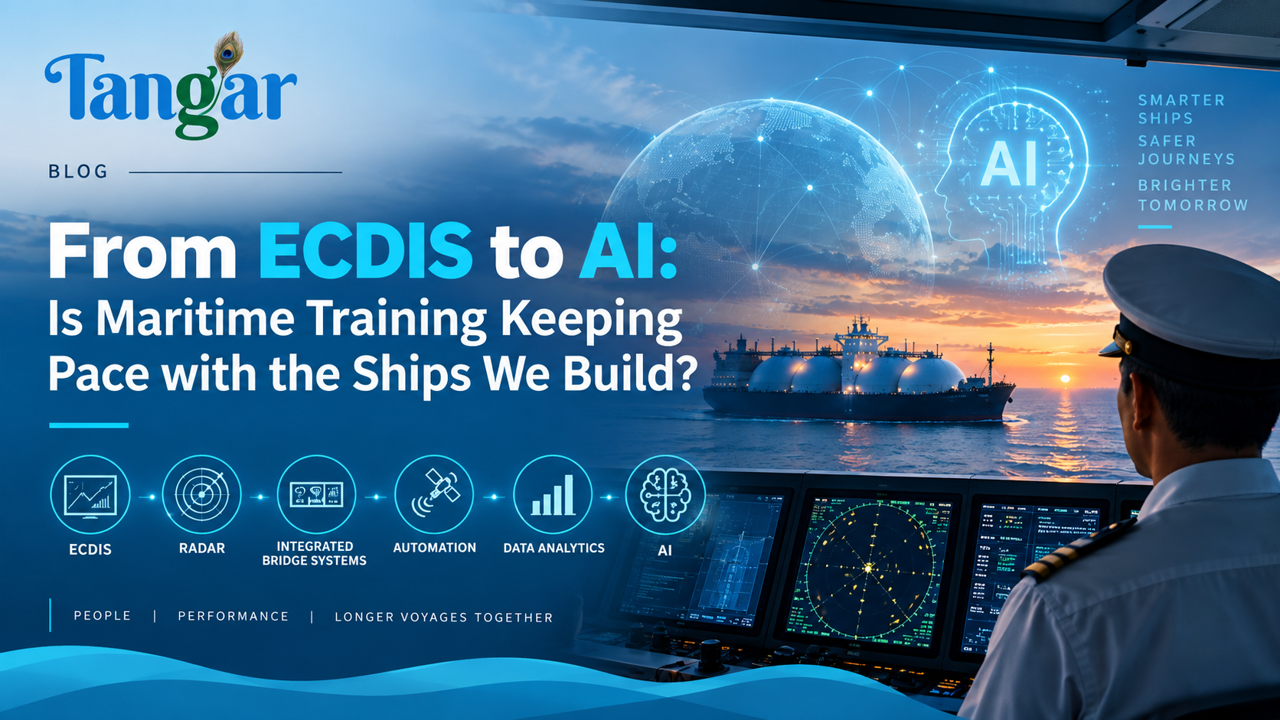
The ships of today are becoming smarter. ECDIS, integrated bridge systems, advanced radar, automation, remote monitoring, predictive maintenance, data-driven decision-making and now Artificial Intelligence (AI) are transforming the way vessels operate.
But this raises an important question:
Are we preparing smarter crews to operate these smarter ships?
Technology is changing. The human role is changing too.
Modern ships provide crews with an enormous amount of information. The challenge is no longer simply finding information.
It is about:
- Understanding what matters
- Knowing what information can be trusted
- Recognising system limitations
- Maintaining situational awareness
- Making the right decision at the right time
- Knowing when not to rely on automation
A crew member may know how to operate an AI-enabled system but true competence means understanding its limitations as well. Technology can support a decision; it cannot replace professional judgement.
From Equipment Knowledge to Systems Awareness
Tomorrow's seafarer needs more than knowledge of individual equipment.
ECDIS, radar, AIS, GPS, gyrocompass, autopilot, alarms and other systems increasingly work together. Crews therefore need to understand how these systems interact and how the information they provide should be evaluated.
The right questions are:
- Where did this information come from?
- Is it reliable?
- Does it agree with what I am observing?
- What happens if the system fails?
- Am I monitoring the technology or is the technology influencing my thinking?
These are not just technical questions.
They are questions of competence, judgement and responsibility.
AI Won't Replace Seafarers. It Will Redefine Their Value.
AI can process huge amounts of data, identify patterns, detect anomalies and support predictions.
But people bring something different: Experience. Context. Accountability. Judgement.
A system may identify an unusual engine parameter. An experienced engineer must understand whether that reading makes sense in the vessel's current operating condition.
A system may recommend a route. A competent navigator must still consider weather, traffic, vessel behaviour, regulations and operational constraints before accepting it.
The future is therefore not simply: Human vs. Machine
It is: Human Expertise + Intelligent Technology
Training Must Become Continuous Training cannot end when a certificate is issued. Technology evolves too quickly.
The maritime industry needs to move towards continuous competence development, including:
- Simulator-based scenarios
- Equipment-specific familiarisation
- AI & automation awareness
- Cybersecurity awareness
- Incident & near-miss learning
- Digital learning modules
- Scenario-based decision making
- Regular competency assessments
The Seafarer of Tomorrow Needs Four Key Capabilities
1.Technical Competence
Understanding onboard equipment, software and systems.
2.Digital Competence
Understanding how data is generated, transferred and used.
3.Critical Thinking
Knowing when to question a system recommendation.
4.Human Competence
Leadership, communication, teamwork, situational awareness and decision-making under pressure.
The Questions Maritime Leaders Should Be Asking
- Instead of simply asking: “Are our crew trained?”
- We should be asking:
- Are our crew trained for the technology they actually use?
- Can they recognise when automation is wrong?
- Can they operate safely when digital systems fail?
- Are we training for tomorrow's vessels or yesterdays?
Building the Crew of the Future
The technological transformation of shipping is not slowing down.
From conventional navigation to ECDIS, integrated digital systems, AI, autonomous technologies and connected vessels the industry is entering a new era.
But technology alone does not create a safer and more efficient vessel.
People do.
At Tangar Ship Management, we believe the future of shipping depends not only on recruiting qualified seafarers, but also on developing crews who can adapt to changing technology, maintain strong operational judgement and perform confidently in increasingly digital environments.
The ships we build are getting smarter.
Our training must get smarter too.
And perhaps the most important question for maritime leaders is:
“Will the next generation of seafarers be ready for it?”