How India Reduced Ship Turnaround Time to Under 24 Hours and What’s Next
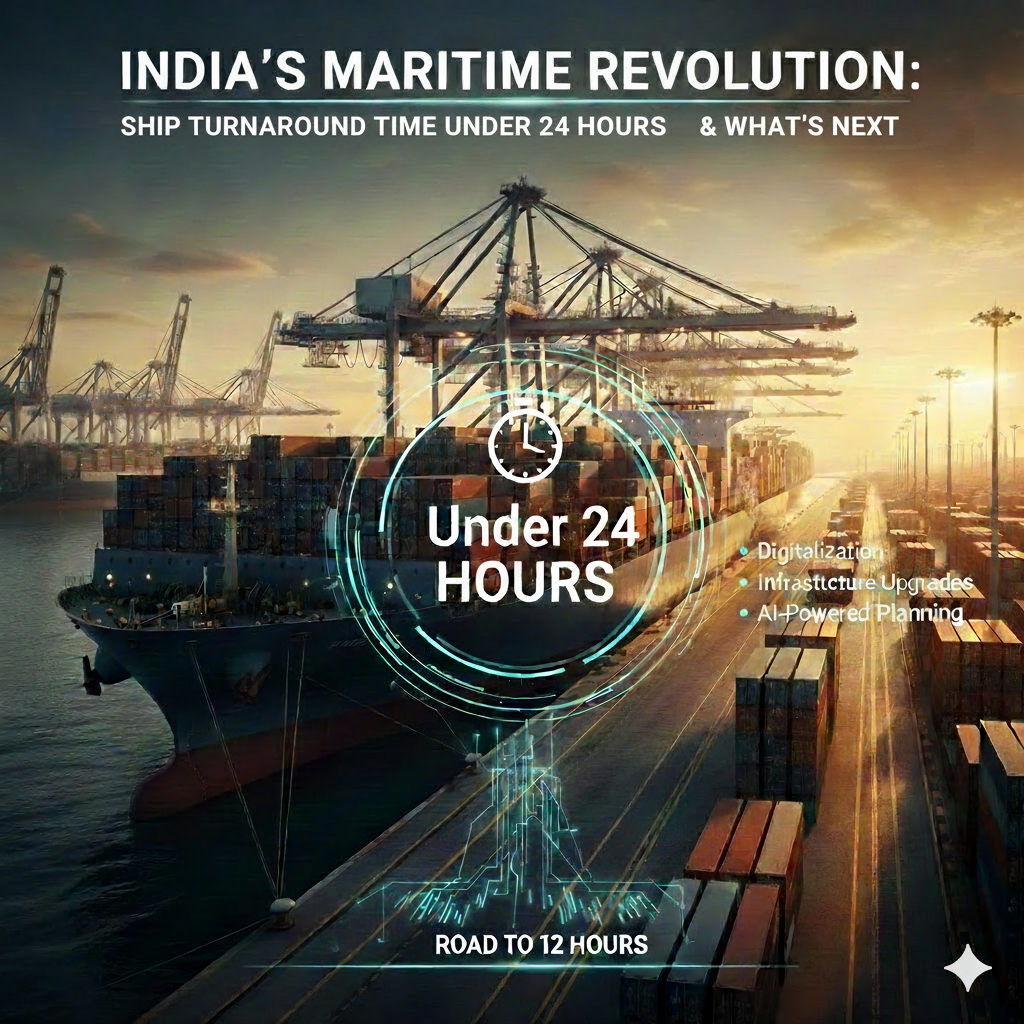
India’s maritime sector is undergoing one of its most significant operational transformations in decades. A milestone once considered ambitious—bringing vessel turnaround time below 24 hours has now become a reality at several major ports. This achievement is more than an operational benchmark; it marks a turning point in how India positions itself within global trade networks.
Why Turnaround Time Matters?
Ship turnaround time is one of the most critical indicators of port efficiency. Faster turnaround enables lower port-stay costs for shipowners, reduces congestion and improves berth availability, accelerates cargo evacuation, enhances reliability across global supply chains, and increases the attractiveness of Indian ports for transshipment and direct port calls. In an industry where time drives profitability, achieving turnaround below 24 hours significantly elevates India’s competitive edge.
What Enabled India’s Breakthrough
India’s progress is not the outcome of a single intervention but a combination of integrated reforms, digitalisation, infrastructure upgrades, and improved coordination among stakeholders.
Large-Scale Port Modernisation:Under the Sagarmala and PM Gati Shakti initiatives, India accelerated berth upgrades, expanded automated yards, strengthened mechanised cargo-handling systems, and advanced dredging and draft improvements. Major ports such as JNPT, Mundra, Kamarajar, and Cochin now operate with modern infrastructure that supports significantly faster vessel servicing.
Nationwide Digital Port Ecosystem:India today operates one of the most digitally integrated port frameworks globally. Key enablers include the Port Community System (PCS 1x), e-berthing and e-cancellation modules, automated gate operations, real-time cargo tracking systems, and unified single-window clearance. Together, these capabilities have reduced paperwork, eliminated redundant approvals, and streamlined coordination across customs, terminals, shipping lines, and port authorities.
Streamlined Customs and Regulatory Processes:
Policy reforms such as faceless assessment, risk-based inspection, pre-arrival documentation, and 24x7 customs processing have sharply reduced administrative delays. These initiatives have removed long-standing bottlenecks, enabling vessels to clear and discharge cargo much faster.
Private Participation and Accountability:
Many of India’s top-performing ports leverage private operators and terminal concessionaires who operate under strict performance KPIs. These include berth productivity, cargo throughput, crane efficiency, and overall vessel turnaround time. This performance-driven culture has triggered healthy competition and elevated operational standards across the port ecosystem.
Impact on Global Trade and Shipowners:
Reducing turnaround time below 24 hours has reshaped the decision-making frameworks of shipowners and charterers. India is increasingly viewed as a faster rotation port, a cost-efficient maritime hub, a reliable gateway for Asian and Middle Eastern trade, and an emerging contender for regional transshipment. Shorter port stays also strengthen voyage economics and schedule reliability—critical parameters for container, tanker, and bulk operators.
What Comes Next: India’s Road to a 12-Hour Turnaround
India’s next objective is even more ambitious. The focus is now on compressing operations further toward a 12-hour turnaround cycle. This will be driven by AI-enabled berth allocation, automated planning, and intelligent vessel traffic management systems; by greener, more energy-efficient ports equipped with electrified equipment, shore-power capabilities, hydrogen-powered vessels, and low-emission terminals; by deeper logistics integration under the Gati Shakti framework to ensure seamless multimodal movement across road, rail, inland waterways, and coastal shipping; by strengthening India’s transshipment capabilities through emerging hubs such as Vizhinjam and Galathea Bay; and by heightened automation across bulk and liquid terminals to achieve faster pumping rates, smoother cargo documentation, and reduced manual intervention.
Conclusion
India’s reduction of vessel turnaround time to under 24 hours is not merely an operational accomplishment—it signals a strategic shift toward becoming a global maritime powerhouse. With sustained investments, advanced technologies, and data-driven logistics frameworks, India is well on its path to building one of the world’s fastest, most efficient, and most reliable port ecosystems.